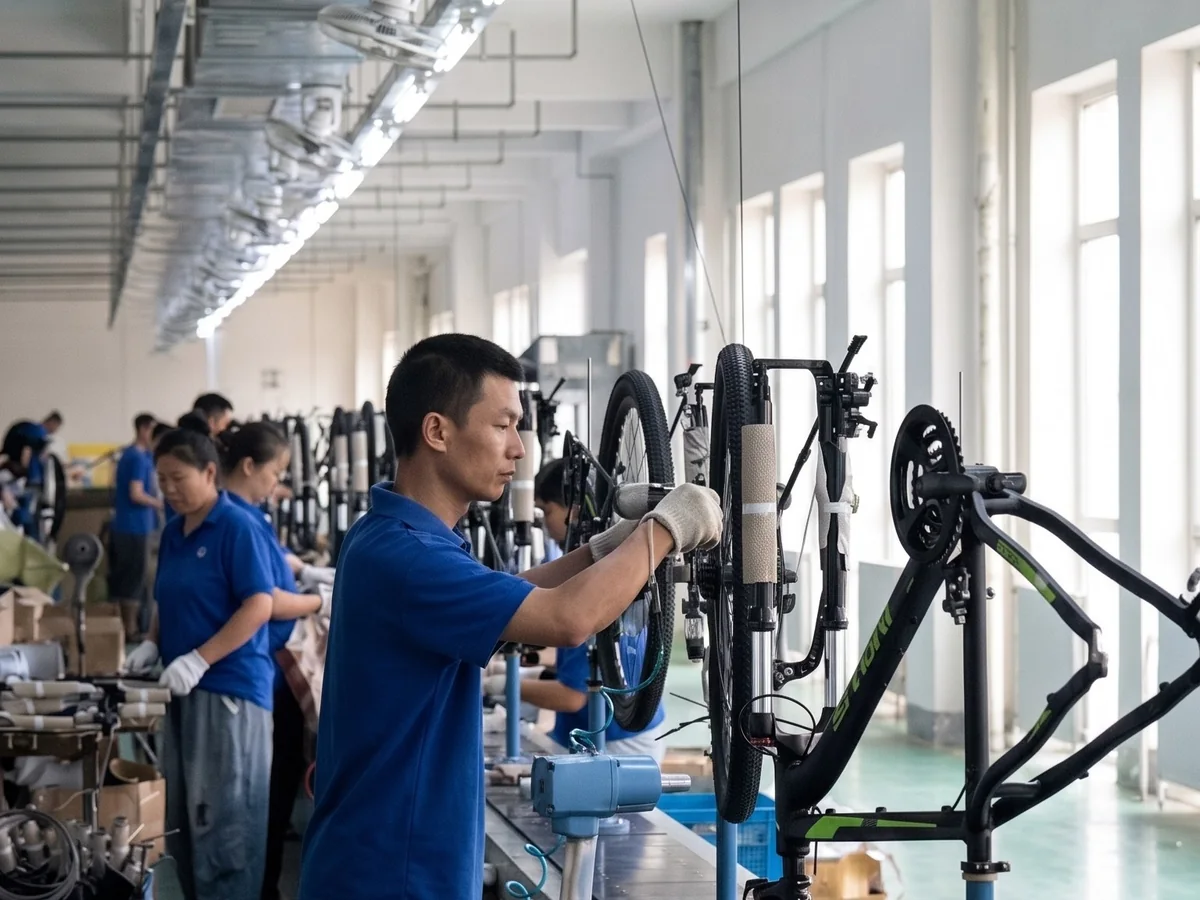
A supplier shortlist often begins with photos, a catalogue and several prices. That is enough to start a conversation, but not enough to decide who should receive sample money or a production deposit. The buyer's real question is whether the proposed team can define one bicycle clearly, build it repeatedly and keep commercial, technical and export records connected.
Use a three-level evidence score
Score every check before comparing suppliers. Use 0 for unclear or contradictory, 1 for a verbal answer without model-specific evidence, and 2 for an answer supported by a current document, record, sample or observable process. The score is not a certification. It is a way to expose unanswered questions before money is committed.
| Decision | Evidence to request | What the buyer is testing |
|---|---|---|
| Who signs and receives payment? | Legal entity name, address, contract party and matching payment instructions. | The commercial counterparty is clear and does not change between quotation, contract and payment. |
| Who performs each production step? | Named roles for product planning, frame supply, paint, assembly, inspection and packing. | The supplier explains its own role and production partners without implying ownership it does not have. |
| Which bicycle is being quoted? | Model code, wheel and frame direction, intended use, reference images and revision date. | Everyone is discussing the same platform rather than a similar-looking catalogue image. |
| What controls the specification? | Itemised BOM, artwork, geometry or size reference, permitted alternatives and approval owner. | Price changes and component substitutions cannot happen invisibly. |
| What will the sample prove? | Sample deliverables, known differences from production, inspection points and approval record. | The sample becomes a controlled reference instead of a one-off showpiece. |
| How is quality checked? | Incoming, assembly, function, finish and packing checks tied to the approved model. | The inspection plan follows the product risk and purchase specification. |
| Which market evidence applies? | Standard, report holder, laboratory, report number, date, tested model and configuration coverage. | A generic logo or component document is not mistaken for evidence covering the ordered bicycle. |
| How will the bicycle arrive? | Assembly level, carton, protection points, manuals, labels, accessories and loading plan. | The handover and landed product match the channel's service capability. |
| What happens after shipment? | Spare-parts assumptions, serial or batch records, issue owner and escalation route. | The project has a traceable support path rather than only a sales contact. |
| Can the order be repeated? | Version-controlled specification, approved artwork, sample record, inspection record and change log. | A repeat order can start from the same reference instead of rebuilding the conversation. |
1. Separate the brand, contracting entity and production site
These may be connected without being identical. Ask which legal entity issues the quotation and contract, where the relevant production stages happen, and who owns each approval. A production partner is not automatically a weakness. An unexplained change of entity, address or responsibility is.
NARVEK, for example, is the market-facing bicycle project brand operated by Horizon (Tangshan) Supply Chain Management Co., Ltd. Bicycle production and quality-control coordination is based in Tianjin, and specialist partner facilities are described as partners where applicable. This visible distinction gives buyers a fact pattern they can verify rather than a vague factory claim.
2. Force the quotation to describe one product
Write a short project brief before asking for revised prices. Include the destination market, buyer type, model or category, rider and use case, expected quantity, target price position, required documents, branding, packaging, assembly level and delivery window. Then ask every supplier to state assumptions and exclusions.
3. Turn the BOM into a change-control document
A bill of materials should identify the approved component direction and how alternatives are handled. The important question is not whether every component can remain unchanged forever. It is whether a proposed change is visible, technically reviewed, priced and approved before it enters production.
- Name or define safety-critical and performance-critical components.
- Record approved equivalents and prohibited substitutions.
- Link artwork, labels, manuals and carton files to the same revision.
- Require written approval for changes that affect fit, function, evidence or customer communication.
4. Decide what the sample must prove
Before the sample is built, define the questions it must answer: fit and geometry direction, component compatibility, finish and artwork, function, assembly, packaging and required records. Note any sample parts that differ from intended production. Approval should capture both what passed and what must change.
This supplier-selection step is different from the later pre-production approval checklist. The supplier evaluation asks whether the proposed process is credible. Pre-production approval releases a defined product into volume production.
5. Connect inspection to the approved bicycle
A generic checklist can miss the risk that matters on the ordered model. Ask how incoming parts, frame condition, wheel and brake setup, assembly torque, electrical functions where applicable, finish, accessories and packing will be checked against the signed specification and sample record. Define who records a deviation and who can accept or reject it.
6. Verify the scope of standards and reports
Do not treat a logo, certificate photo or component report as automatic coverage for the complete bicycle. Ask for the applicable standard, report number, issuing laboratory or body, holder, test date, tested model and configuration. The destination market and actual SKU determine what evidence is relevant.
For context, ISO 4210-2:2023 addresses safety and performance requirements for common bicycle categories, while the U.S. Consumer Product Safety Commission points businesses to 16 CFR Part 1512 for bicycle requirements. Electric bicycle and lithium-battery projects add system and transport questions. These references help frame questions; they do not prove that a specific NARVEK or supplier model is covered.
7. Audit the handover, not only the assembly line
A bicycle can leave production correctly and still arrive as a poor retail product if packing, manuals, labels, accessories or assembly expectations are unclear. Confirm carton protection, assembly level, included tools or parts, documentation language, barcode and label responsibilities, and the records that travel with the shipment.
8. Make communication part of the audit
Useful communication is not simply fast. It keeps one issue owner, names assumptions, records decisions and distinguishes a proposal from an approval. During supplier evaluation, introduce one controlled change—such as a brake, paint or packaging requirement—and observe whether the quotation, BOM, artwork and timing implications stay connected.
9. Use red flags as pause points
- The payee or contracting entity changes without a documented reason.
- Model photos are available but no model code or written specification is offered.
- Compliance is answered only with “CE available” or another label without report scope.
- The sample is described as “similar” without a list of differences.
- Component substitutions are treated as a production decision rather than a buyer approval.
- Factory ownership, capacity or customer claims cannot be separated from production-partner roles.
- Packaging and after-shipment responsibilities appear only after the product price is agreed.
10. Finish with a controlled next step
The next step does not need to be a production order. It can be a document review, model-specific quotation, live process walkthrough, paid sample with defined deliverables, or independent audit. Choose the smallest step that can resolve the largest remaining uncertainty.
Frequently asked questions
What makes two OEM bicycle quotations comparable?
Both must cover the same model definition, frame and wheel direction, BOM, branding, packaging, assembly level, document scope, quantity and delivery basis.
Is a factory certificate enough to approve a bicycle supplier?
No. Check the holder, site, scope, date, issuing body and model relevance, then connect that evidence to the ordered specification, sample and inspection plan.
Should I reject a supplier that uses production partners?
Not automatically. Require transparent roles, a clear contracting entity, controlled records and named responsibility for every approval and change.
When should I arrange a third-party audit or inspection?
Consider it when order value, product risk, a new supplier relationship, destination-market obligations or unresolved evidence gaps justify independent verification.
What should be confirmed before paying for a sample?
Confirm the legal payee, model code, market, use case, reference specification, customisation scope, deliverables, known differences, document expectations and approval method.
Primary reference points
- ISO 4210-2:2023 — bicycle safety and performance requirements
- U.S. CPSC — Bicycle Requirements Business Guidance
- EUR-Lex — Regulation (EU) 2023/988 on general product safety
- IATA — lithium battery transport guidance
